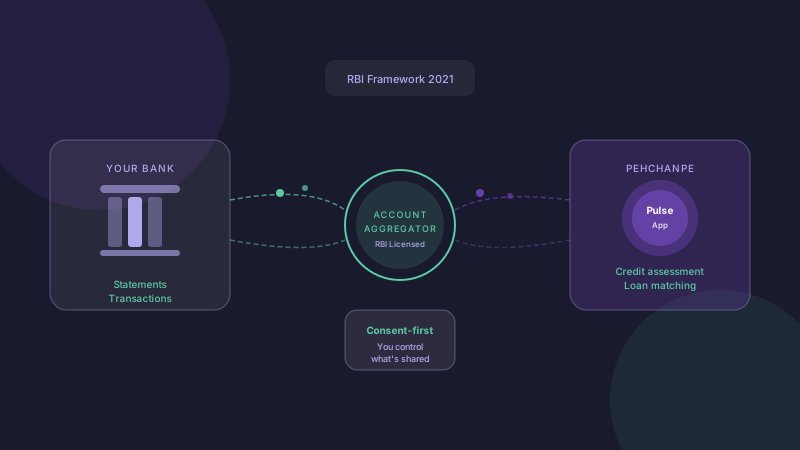
Account Aggregator: The Secure Way to Share Your Bank Statements With a Lender
- PehchanPe Team
- February 18, 2026
- 03 Mins read
- How It Works , Technology
Until recently, sharing bank statements with a lender meant downloading a PDF, sometimes entering a password, and uploading the file to their portal. Lenders then had to manually verify the document, and the process was slow, error-prone, and open to fraud.
Account Aggregator (AA) changes all of this. It is one of the most significant infrastructure upgrades in Indian lending, and understanding how it works will help you use it with confidence.
What is Account Aggregator?
Account Aggregator is a consent-based data sharing framework licensed and regulated by the Reserve Bank of India. It creates a secure, standardised channel between your bank (a Financial Information Provider, or FIP) and any entity you choose to share your data with, such as a lender (a Financial Information User, or FIU).
The framework launched in 2021 and is now supported by all major banks including SBI, HDFC, ICICI, Axis, Kotak, and several others, as well as many NBFCs and fintechs.
How does it work in practice?
When a lender requests your bank statements via Account Aggregator:
- You receive a notification on your phone from the Account Aggregator app (or within the lender’s app)
- The notification shows exactly what data is requested, which accounts are included, the purpose, and how long the lender will hold the data
- You review and either approve or decline
- If you approve, the data flows directly from your bank to the lender in a machine-readable, tamper-proof format
- The Account Aggregator itself never reads your data; it only routes the encrypted data package
Your consent is specific: you can approve sharing 6 months of one account while excluding another account entirely.
Why this is better than uploading a PDF
Authenticity: Bank statement PDFs can be edited. Data flowing through the Account Aggregator framework carries a digital certificate from the bank confirming it has not been altered.
Speed: Lenders can process AA data instantly with automated systems. Manual review of PDF statements typically takes one to three days.
Control: You grant consent for a specific purpose and time period. You can revoke it at any time through the AA app, even after the data has been shared.
No passwords shared: You never give your bank login credentials to a third party. The consent flow is bank-to-lender with you in the middle, not lender-through-your-account.
Which Account Aggregators are licensed?
As of 2026, the following entities hold live AA licences from the RBI: Finvu, CAMS Finserv, OneMoney, PhonePe, Perfios, and NADL. When a lender asks you to share data via AA, they will specify which licensed aggregator they use.
Does this affect my credit score?
No. Sharing your bank data via Account Aggregator does not trigger a hard enquiry on your credit report. It is purely a financial data fetch, separate from the credit bureau check that lenders do to pull your CIBIL or Experian score.
What if I decline to share data via AA?
Lenders cannot legally refuse your application solely because you declined an AA consent request. However, without bank statement data, they have less information to assess your repayment ability, which may result in a lower loan amount being offered or a higher interest rate to compensate for the uncertainty.
If you are uncomfortable sharing data via a specific aggregator, you can ask the lender whether they accept PDF statements or whether another AA provider is available.
Using AA with PehchanPe
When you apply through PehchanPe Pulse, the application flow offers Account Aggregator-based statement sharing as the default option. The consent form is shown clearly before anything is submitted, and you can see exactly which lender will receive your data and for how long.
If you have questions about how your data is used, write to us at support@pehchanpe.com and we will respond within one working day.